I have just been reading Falconer’s Lure too!!!!!! We have to read H is for Hawk for school, and I thought, well, I know lots of it from Falconer’s Lure, and I was checking something, and just started reading it again.
Do you think maybe Alex should read it too? JIC? Alex, you can buy it from, no you can’t, I just checked, and http://www.ggbp.co.uk/ don’t seem to have it any more, then I checked Amazon, and you definitely can’t afford their prices! Sorry. Anyway, it probably doesn't mean anything.
Wednesday, November 11


Monday, November 9
A funny thing happened ……
And I am glad we are back up, so to speak. Anyway, I was reading Falconer’s Lure (Sandy will know what I mean, even if you don’t Alex!) and Peter said:
“I read an absolutely terrifying book once about the moon being pushed out of its proper path and crashing into the earth. I s’pose it could happen!”
Isn’t that a bit spooky?
Wednesday, November 4
Not exactly beachcombing–but what a find!

A spate of shipwrecks recently found near a group of Greek islands has given researchers new insights into how trade routes and sailing technology evolved in the Eastern Mediterranean. And with more exploration planned, additional discoveries are still likely.
The find is remarkable both for the sheer number of wrecks in the small area and the range of time periods the vessels came from.
The earliest wreck dates to the Archaic Period (700-480 B.C.), while the most recent is from the Late Medieval Period (16th century A.D.). Ships from the Classical Period (480-323 B.C.) and the Hellenistic Period (323-31 B.C.) were also found, though a majority—12 of the 22—sailed and sank at some point during the Late Roman Period (300-600 A.D.)
Saturday, October 31
Ask the right people…………...
Scientists are keeping a close eye on a big asteroid that may pose an impact threat to Earth in a few decades.
The space rock, which is called 2011 AG5, is about 460 feet (140 meters) wide.
It may come close enough to Earth in 2040 that some researchers are calling for a discussion about how to deflect it.

Friday, October 30
Apologies for the lack of posting!

Due to Google’s increased security, we (me, Sandy and Lexie) were locked out of the blog. Google said we were using it from a device not used before, which was not true in the case of any of us! But it seems to have fixed the problem now!
Wednesday, January 14

Saturday, January 3

Wednesday, December 10
Thursday, September 18

Sunday, September 14
Firing on the Foreshore
Pots made from Thames river clay were fired in two bonfires constructed on the foreshore from Thames driftwood - an ancient London tradition going back more than 5,000 years.
(Last year the tides must have been more favourable, as it seems to have been happening at dusk, which would be that much more atmospheric – maybe next year, maybe we could all do it?)

Firing pots

Then the tide comes in
Saturday, September 13
Mudlarking by the Thames
This is the urban equivalent of beachcombing - looking on the beach for 'treasures' washed in by the sea – and today, for the third time, I spent several hours wandering around, picking up things and photographing others.
It was a special ‘open day’ as part of Totally Thames, the totally pants name for what used to be the Thames Festival.
Have a look here for finds that will make you green with envy – well, they do me! https://sites.google.com/site/thamesandfield/river-finds-1
Here are a couple of my photos

Remains of a cartwheel

Used to anchor ships pulled up onto the beach for repair.
Friday, August 15

Sunday, August 10
Don’t miss these photographs
Astronaut captures out-of-this-world photos of the 'supermoon-set' as it dips behind the Earth and stunning images from cities across the world.
http://www.dailymail.co.uk/news/article-2721202/Jaw-dropping-Photos-reveal-supermoon-outshining-Perseid-shower-fireball-champion-meteors-reaches-moon-Sunday-night.html#ixzz3A0okaCJc

Saturday, August 9
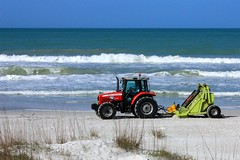
Is this what beachcombing has come to?
“The little red tractor-beachcomber is busy combing our beach every morning along with two others – one blue and one green.” (http://alexandrazonis.com/tag/beachcomber/)
Apparently yes, just did a quick Internet search and returned over 264,000 results – not all relevant, but including something from Popular Mechanics in 1935 – but it was for cleaning the beach, but not beachcombing as we know it.
Sunday, June 22
July 2013….
….. I dropped my camera phone in the sea for a very few seconds; it buzzed and died. I buried it in rice for some days. Still wouldn’t charge up. I left it in my underwear drawer until a few weeks ago, when I took it out, and connected it to a charger – and it charged up.
But it wouldn’t let me download my photos,not nohow. And now today, success. I was able to connect to wifi, and email the photos, and then (just experimenting) found Bluetooth was now working and I transferred the photos to my current phone. So beachcombing last year I came across this..

Saturday, May 3
Been there, done that! We know what it feels like!
Star cluster hurtling towards earth
The Independent
A galaxy has thrown out a star cluster towards earth at more than two million miles per hour. But it is, thankfully, likely to miss our planet and “drift through the void between the galaxies for all time,” says the Harvard-Smithsonian Center for Astrophysics.
See last chapter of The Stone Summons - - - Buy Now! - also on Kindle
Wednesday, April 16
Tuesday, April 15

Tuesday, February 25
The dark side of the moon lit up…….
Astronomers have recorded a car-sized meteorite crashing into the Moon which created the longest and brightest lunar impact ever that was visible from Earth.
The meteorite weighing almost half a tonne hit the lunar surface in September last year, in Mare Nubium, or Sea of Clouds, a massive impact basin itself, one that filled with lava billions of years ago. This molten rock then froze in place, erasing much of the old craters that then populated the basin.
It now stretches across some 95,000 square miles (245,000 square kilometres) of the southern left portion of the moon’s face and it is easily identified with the naked eye or binoculars as a visibly dark patch on the face of the moon.
The impact produced an extraordinary flash which is the longest and brightest ever recorded on the Moon, the astronomers said.

This artwork depicts the blast formed from an impacting meteor on the lunar surface. Credit: NASA
Subscribe to:
Posts (Atom)