Tuesday, August 23

Beachcombing is a longstanding tradition on Texel, the largest of Holland's West Frisian Islands

What washes up on the island's shores? Apparently airplane propellers. Jars of money. Mammoth bones. Lots of messages in bottles.

The nearby shipping lanes, strong currents, and steady winds make Texel a magnet for anything adrift in Northern Europe…..

http://www.coastalliving.com/travel/other-coasts/treasure-island-texel-netherlands

Seashells

Thursday, August 18

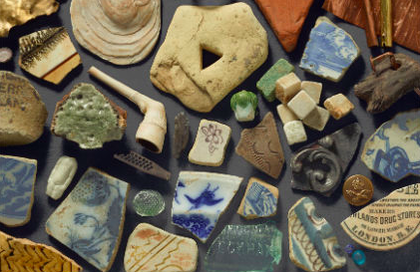
Mudlarking

Rsz screen shot 2016 08 14 at 83356 pm 2.png?ixlib=rails 1.1

“the sound and smell of dying centuries” of the "river highway"  [It’s basically a book review, but interesting]
http://www.splicetoday.com/writing/london-in-fragments-a-mudlark-s-treasure


Tuesday, August 16

Stubby Squid

image

A species that looks like a cross between an octopus and a squid, but is most closely related to a cuttlefish. "This species spends life on the seafloor, activating a sticky mucus jacket and burrowing into the sediment to camouflage, leaving their eyes poking out to spot prey like shrimp and small fish,"

https://www.youtube.com/watch?v=lEhYJEQmExE

Friday, July 22

New Jersey beachcomber finds mystery U.S. Army ring

071816_ArmyringJerseyShore

Viral search for owner highlights life of man with a metal detector

http://www.phillyvoice.com/new-jersey-beachcomber-finds-mystery-us-army-ring/

I always wanted to know what a sand dollar is!

As a beachcomber, Pamela Doyle says sand dollars can be elusive. She found this sand dollar propped perfectly on some seaweed. 'I was very lucky,' she said.

http://www.cbc.ca/news/canada/prince-edward-island/pei-instagram-takeover-pamela-doyle-oceanluvngal-1.3677435

So I looked it up, guess this one is more of a biscuit

The term sand dollar refers to species of extremely flattened, burrowing sea urchins belonging to the order Clypeasteroida. Some species within the order, not quite as flat, are known as sea biscuits

Saturday, July 9

FAMILY EXCURSIONS - Beachcombing

Yesterday's Island/Today's Nantucket (blog)

Beachcombing is simply searching the shores for items of interest. I find myself collecting seashells each time I go to the beach. There is always a shell ...

image

Sunday, June 12

Wowie! I’m moving.

Tim Davies has collected more 2000 coins and other items with his metal detector after last weekend’s storms, at Ettalong Beach.

Wednesday, June 8

This we heard, remember?

The 'song' of ancient stars

Scientists in Britain have recorded rhythms of a 13-billion-year-old star cluster. The 'music' is captivating, and it is also instrumental in furthering our understanding of the origins of the Milky Way Galaxy.

image

Saturday, February 13

Please vote now : παρακαλούμε να ψηφίσετε τώρα

Greek islanders who have been on the frontline of the refugee crisis are to be nominated for the Nobel peace prize with the support of their national government.

Of the 900,000 refugees who entered Europe last year most were received –scared, soaked and travelling in rickety boats – by those who live on the Greek islands in the Aegean Sea.

The islanders, including fishermen who gave up their work to rescue people from the sea, are in line to be honoured with one of the world’s most esteemed awards. Eminent academics from the universities of Oxford, Princeton, Harvard, Cornell and Copenhagen are drafting a submission in favour of awarding the prize to the people of Lesbos, Kos, Chíos, Samos, Rhodes and Leros.

Sign the petition at https://secure.avaaz.org/en/nobel_prize_greek_islanders_21/?pv=73&rc=fb

Tuesday, January 26

This is what I found on our beach!


Not my cat, Mavros, as some of you will know, he is black!  And some may have guessed!

Monday, January 18

Kaboom: Russia has an unsubtle plan about how to deflect asteroidsKaboom: Russia has an unsubtle plan about how to deflect asteroids

Could Russia's plan to 'nuke' doomsday asteroids save the world from apocalypse?
Russia is working on a scheme to save humanity from asteroids by blasting them with nuclear weapons.

This is seen as a better option than simply blowing them to smithereens - a tactic which could end up showering Earth with radioactive comets.   Oh yes, I remember that bit!

Saturday, January 16

Stargazing

British television with a brand new project – Pulsar Hunters. We need your help to discover unknown pulsars. These are the dense, fast-spinning cores of dead stars. Get involved in the biggest Zooniverse event of the year at www.pulsarhunters.org.
As the neutron star spins, beams of radio waves from its magnetic poles sweep across our line of sight so it flashes like a cosmic lighthouse. Radio telescopes can be used to detect this very regular 'tick-tock' of a spinning pulsar. But discovering new pulsars is like finding a needle in a haystack. We must search for their faint, repeating signals hidden among terrestrial radio interference from devices like mobile phones, radars and telecommunications equipment.


Thursday, January 14

Have they tried throwing stones?

So, I'm being facetious!  NASA has set up an asteroid defense team to protect the Earth from potentially threatening celestial bodies that could strike our planet, damage our environment and even wipe us out, the US Government’s space agency announced last week.


Monday, January 11

So I didn't like it looked like a potato! (See below)


Stones of strata

This morning I found all three of these stones.  The top one is better than this, {I know, looks a bit like a potato!} but the other two are quite good I think.  I was wondering whether to photograph them or what, when I remembered that I had scanned Karagiozi when I first found him and it turned out well.  - Today's Find (Actually it was the day before I started the new blog, but I wanted to be dramatic.)


Tuesday, December 29

Planet Earth could be at higher risk of a space rock impact

Centaur, or giant, comets Earth are likely to fall apart into dust and massive fragments that will flood the inner solar system with cometary debris and would make inevitable impacts on Earth.

And the answer?  Fling the stones that put the stars to flight!


Monday, December 28

I hope you saw it too!


On Christmas Day, there will be a full moon, the first since 1977.

This full moon, the last one for 2015, is called a Full Cold Moon because it happens during the start of winter.

A full moon on Christmas won't happen again until 2034.

Sunday, December 13

Comforting? I think not, but interesting

Star Wars: How to build a Death Star, according to Nasa

On an asteroid you have 'all the building blocks you would need to build your family Death Star'
"It could provide the metals. You have organic compounds, you have water - all the building blocks you would need to build your family Death Star,"
http://www.independent.co.uk/news/science/star-wars-how-to-build-a-death-star-according-to-nasa-a6771466.html

Sunday, November 22

Beachcombing!

image

Well, perhaps not, though it is on the beach.  It is from old stuff from the Pier, where it is being rebuilt after a fire.  See http://hastingspeerlesspier.blogspot.co.uk/  for lots of information

Thursday, November 19

We have two beaches!

And one is mostly sand, the other one is rocks and sand, then sand, then along by the beach huts it is pebbles, and then sand.  I’ll try to get some photos later.

That’s funny!

Our pebbles come first, then the sand, and mostly only at low tide.  How about you Sandy?

image

Wednesday, November 18

I like mine better–and it is the Greek colours

(Alright, I did play around with it a bit!  But it was on the sand, above the pebbles, on our beach.)


image

Wednesday, November 11

You think that’s spooky!

I have just been reading Falconer’s Lure too!!!!!!  We have to read H is for Hawk for school, and I thought, well, I know lots of it from Falconer’s Lure, and I was checking something, and just started reading it again.
Do you think maybe Alex should read it too?  JIC?  Alex, you can buy it from, no you can’t, I just checked, and http://www.ggbp.co.uk/ don’t seem to have it any more, then I checked Amazon, and you definitely can’t afford their prices! Sorry.  Anyway, it probably doesn't mean anything.

Monday, November 9

A funny thing happened ……

And I am glad we are back up, so to speak.  Anyway, I was reading Falconer’s Lure (Sandy will know what I mean, even if you don’t Alex!) and Peter said:

“I read an absolutely terrifying book once about the moon being pushed out of its proper path and crashing into the earth.  I s’pose it could happen!”

Isn’t that a bit spooky?

Wednesday, November 4

Not exactly beachcombing–but what a find!

Picture of ancient shipwreck

A spate of shipwrecks recently found near a group of Greek islands has given researchers new insights into how trade routes and sailing technology evolved in the Eastern Mediterranean. And with more exploration planned, additional discoveries are still likely.

The find is remarkable both for the sheer number of wrecks in the small area and the range of time periods the vessels came from.

The earliest wreck dates to the Archaic Period (700-480 B.C.), while the most recent is from the Late Medieval Period (16th century A.D.). Ships from the Classical Period (480-323 B.C.) and the Hellenistic Period (323-31 B.C.) were also found, though a majority—12 of the 22—sailed and sank at some point during the Late Roman Period (300-600 A.D.)

Saturday, October 31

Ask the right people…………...

Scientists are keeping a close eye on a big asteroid that may pose an impact threat  to Earth in a few decades.

The space rock, which is called 2011 AG5, is about 460 feet (140 meters) wide.

It may come close enough to Earth in 2040 that some researchers are calling for a discussion about how to deflect it.

image

Friday, October 30

Apologies for the lack of posting!

image

Due to Google’s increased security, we (me, Sandy and Lexie) were locked out of the blog.  Google said we were using it from a device not used before, which was not true in the case of any of us!  But it seems to have fixed the problem now!

Sunday, September 14

Firing on the Foreshore

Pots made from Thames river clay were fired in two bonfires constructed on the foreshore from Thames driftwood - an ancient London tradition going back more than 5,000 years.

(Last year the tides must have been more favourable, as it seems to have been happening at dusk, which would be that much more atmospheric – maybe next year, maybe we could all do it?)

image

Firing pots

image

Then the tide comes in

Saturday, September 13

Mudlarking by the Thames

This is the urban equivalent of beachcombing - looking on the beach for 'treasures' washed in by the sea – and today, for the third time, I spent several hours wandering around, picking up things and photographing others.

It was a special ‘open day’ as part of Totally Thames, the totally pants name for what used to be the Thames Festival.

Have a look here for finds that will make you green with envy – well, they do me!  https://sites.google.com/site/thamesandfield/river-finds-1

Here are a couple of my photos

image

Remains of a cartwheel

image

Used to anchor ships pulled up onto the beach for repair.

Saturday, August 9

Is this what beachcombing has come to?

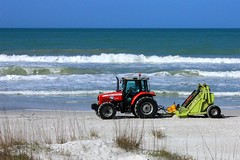
“The little red tractor-beachcomber is busy combing our beach every morning along with two others – one blue and one green.” (http://alexandrazonis.com/tag/beachcomber/)

Apparently yes, just did a quick Internet search and returned over 264,000 results – not all relevant, but including something from Popular Mechanics in 1935 – but it was for cleaning the beach, but not beachcombing as we know it.

Beachcombing Tractor

Sunday, June 22

July 2013….

….. I dropped my camera phone in the sea for a very few seconds; it buzzed and died.  I buried it in rice for some days.  Still wouldn’t charge up.  I left it in my underwear drawer until a few weeks ago, when I took it out, and connected it to a charger – and it charged up.

But it wouldn’t let me download my photos,not nohow.  And now today, success.  I was able to connect to wifi, and email the photos, and then (just experimenting) found Bluetooth was now working and I transferred the photos to my current phone.  So beachcombing last year I came across this..

image

Saturday, May 3

Been there, done that! We know what it feels like!

Star cluster hurtling towards earth

The Independent
 
A galaxy has thrown out a star cluster towards earth at more than two million miles per hour. But it is, thankfully, likely to miss our planet and “drift through the void between the galaxies for all time,” says the Harvard-Smithsonian Center for Astrophysics.

See last chapter of  The Stone Summons - - - Buy Now! - also on Kindle

Tuesday, February 25

The dark side of the moon lit up…….

Astronomers have recorded a car-sized meteorite crashing into the Moon which created the longest and brightest lunar impact ever that was visible from Earth.

The meteorite weighing almost half a tonne hit the lunar surface in September last year, in Mare Nubium, or Sea of Clouds, a massive impact basin itself, one that filled with lava billions of years ago. This molten rock then froze in place, erasing much of the old craters that then populated the basin.

It now stretches across some 95,000 square miles (245,000 square kilometres) of the southern left portion of the moon’s face and it is easily identified with the naked eye or binoculars as a visibly dark patch on the face of the moon.

The impact produced an extraordinary flash which is the longest and brightest ever recorded on the Moon, the astronomers said.

moon-impact2

This artwork depicts the blast formed from an impacting meteor on the lunar surface. Credit: NASA

Saturday, January 11

The dark side of the moon is turquoise, say astronomers

http://www.theguardian.com/science/2014/jan/10/dark-side-moon-turquoise-astronomers?CMP=ema_632

Measurements from a telescope in Hawaii mean that pedants may now argue that, technically speaking, if one wanted to be entirely accurate, the side of the moon referred to in Pink Floyd's 1973 album The Dark Side of the Moon should really be described as "turquoise".

The dark side of the moon is not the same as the far side, which gets as much sunlight as the side facing us.  The dark side is not lit directly by sunlight, but by light reflected from Earth.  It is much fainter, and best seen around the time of the new moon.

"This is sunshine that struck the Earth, was coloured by the Earth, was reflected up to the moon, struck the moon, and then came back to us."