
Monday, January 11


Stones of strata
This morning I found all three of these stones. The top one is better than this, {I know, looks a bit like a potato!} but the other two are quite good I think. I was wondering whether to photograph them or what, when I remembered that I had scanned Karagiozi when I first found him and it turned out well. - Today's Find (Actually it was the day before I started the new blog, but I wanted to be dramatic.)

Sunday, January 10

Saturday, January 9

Thursday, January 7

Wednesday, January 6

Monday, January 4

Friday, January 1

Tuesday, December 29
Planet Earth could be at higher risk of a space rock impact
Centaur, or giant, comets Earth are likely to fall apart into dust and massive fragments that will flood the inner solar system with cometary debris and would make inevitable impacts on Earth.
And the answer? Fling the stones that put the stars to flight!

And the answer? Fling the stones that put the stars to flight!

Monday, December 28
I hope you saw it too!

On Christmas Day, there will be a full moon, the first since 1977.
This full moon, the last one for 2015, is called a Full Cold Moon because it happens during the start of winter.
A full moon on Christmas won't happen again until 2034.
Sunday, December 13
Comforting? I think not, but interesting
Star Wars: How to build a Death Star, according to Nasa
On an asteroid you have 'all the building blocks you would need to build your family Death Star'"It could provide the metals. You have organic compounds, you have water - all the building blocks you would need to build your family Death Star,"
http://www.independent.co.uk/news/science/star-wars-how-to-build-a-death-star-according-to-nasa-a6771466.html

Sunday, November 22
Beachcombing!

Well, perhaps not, though it is on the beach. It is from old stuff from the Pier, where it is being rebuilt after a fire. See http://hastingspeerlesspier.blogspot.co.uk/ for lots of information
Thursday, November 19
We have two beaches!
And one is mostly sand, the other one is rocks and sand, then sand, then along by the beach huts it is pebbles, and then sand. I’ll try to get some photos later.
That’s funny!
Our pebbles come first, then the sand, and mostly only at low tide. How about you Sandy?

Wednesday, November 18
I like mine better–and it is the Greek colours
(Alright, I did play around with it a bit! But it was on the sand, above the pebbles, on our beach.)

Sunday, November 15

Friday, November 13

Wednesday, November 11
You think that’s spooky!
I have just been reading Falconer’s Lure too!!!!!! We have to read H is for Hawk for school, and I thought, well, I know lots of it from Falconer’s Lure, and I was checking something, and just started reading it again.
Do you think maybe Alex should read it too? JIC? Alex, you can buy it from, no you can’t, I just checked, and http://www.ggbp.co.uk/ don’t seem to have it any more, then I checked Amazon, and you definitely can’t afford their prices! Sorry. Anyway, it probably doesn't mean anything.
Do you think maybe Alex should read it too? JIC? Alex, you can buy it from, no you can’t, I just checked, and http://www.ggbp.co.uk/ don’t seem to have it any more, then I checked Amazon, and you definitely can’t afford their prices! Sorry. Anyway, it probably doesn't mean anything.
Monday, November 9
A funny thing happened ……
And I am glad we are back up, so to speak. Anyway, I was reading Falconer’s Lure (Sandy will know what I mean, even if you don’t Alex!) and Peter said:
“I read an absolutely terrifying book once about the moon being pushed out of its proper path and crashing into the earth. I s’pose it could happen!”
Isn’t that a bit spooky?
Wednesday, November 4
Not exactly beachcombing–but what a find!

A spate of shipwrecks recently found near a group of Greek islands has given researchers new insights into how trade routes and sailing technology evolved in the Eastern Mediterranean. And with more exploration planned, additional discoveries are still likely.
The find is remarkable both for the sheer number of wrecks in the small area and the range of time periods the vessels came from.
The earliest wreck dates to the Archaic Period (700-480 B.C.), while the most recent is from the Late Medieval Period (16th century A.D.). Ships from the Classical Period (480-323 B.C.) and the Hellenistic Period (323-31 B.C.) were also found, though a majority—12 of the 22—sailed and sank at some point during the Late Roman Period (300-600 A.D.)
Saturday, October 31
Ask the right people…………...
Scientists are keeping a close eye on a big asteroid that may pose an impact threat to Earth in a few decades.
The space rock, which is called 2011 AG5, is about 460 feet (140 meters) wide.
It may come close enough to Earth in 2040 that some researchers are calling for a discussion about how to deflect it.

Friday, October 30
Apologies for the lack of posting!

Due to Google’s increased security, we (me, Sandy and Lexie) were locked out of the blog. Google said we were using it from a device not used before, which was not true in the case of any of us! But it seems to have fixed the problem now!
Wednesday, January 14

Saturday, January 3

Wednesday, December 10
Thursday, September 18

Sunday, September 14
Firing on the Foreshore
Pots made from Thames river clay were fired in two bonfires constructed on the foreshore from Thames driftwood - an ancient London tradition going back more than 5,000 years.
(Last year the tides must have been more favourable, as it seems to have been happening at dusk, which would be that much more atmospheric – maybe next year, maybe we could all do it?)

Firing pots

Then the tide comes in
Saturday, September 13
Mudlarking by the Thames
This is the urban equivalent of beachcombing - looking on the beach for 'treasures' washed in by the sea – and today, for the third time, I spent several hours wandering around, picking up things and photographing others.
It was a special ‘open day’ as part of Totally Thames, the totally pants name for what used to be the Thames Festival.
Have a look here for finds that will make you green with envy – well, they do me! https://sites.google.com/site/thamesandfield/river-finds-1
Here are a couple of my photos

Remains of a cartwheel

Used to anchor ships pulled up onto the beach for repair.
Friday, August 15

Sunday, August 10
Don’t miss these photographs
Astronaut captures out-of-this-world photos of the 'supermoon-set' as it dips behind the Earth and stunning images from cities across the world.
http://www.dailymail.co.uk/news/article-2721202/Jaw-dropping-Photos-reveal-supermoon-outshining-Perseid-shower-fireball-champion-meteors-reaches-moon-Sunday-night.html#ixzz3A0okaCJc

Saturday, August 9
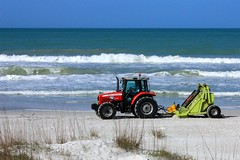
Is this what beachcombing has come to?
“The little red tractor-beachcomber is busy combing our beach every morning along with two others – one blue and one green.” (http://alexandrazonis.com/tag/beachcomber/)
Apparently yes, just did a quick Internet search and returned over 264,000 results – not all relevant, but including something from Popular Mechanics in 1935 – but it was for cleaning the beach, but not beachcombing as we know it.
Sunday, June 22
July 2013….
….. I dropped my camera phone in the sea for a very few seconds; it buzzed and died. I buried it in rice for some days. Still wouldn’t charge up. I left it in my underwear drawer until a few weeks ago, when I took it out, and connected it to a charger – and it charged up.
But it wouldn’t let me download my photos,not nohow. And now today, success. I was able to connect to wifi, and email the photos, and then (just experimenting) found Bluetooth was now working and I transferred the photos to my current phone. So beachcombing last year I came across this..

Saturday, May 3
Been there, done that! We know what it feels like!
Star cluster hurtling towards earth
The Independent
A galaxy has thrown out a star cluster towards earth at more than two million miles per hour. But it is, thankfully, likely to miss our planet and “drift through the void between the galaxies for all time,” says the Harvard-Smithsonian Center for Astrophysics.
See last chapter of The Stone Summons - - - Buy Now! - also on Kindle
Wednesday, April 16
Tuesday, April 15

Tuesday, February 25
The dark side of the moon lit up…….
Astronomers have recorded a car-sized meteorite crashing into the Moon which created the longest and brightest lunar impact ever that was visible from Earth.
The meteorite weighing almost half a tonne hit the lunar surface in September last year, in Mare Nubium, or Sea of Clouds, a massive impact basin itself, one that filled with lava billions of years ago. This molten rock then froze in place, erasing much of the old craters that then populated the basin.
It now stretches across some 95,000 square miles (245,000 square kilometres) of the southern left portion of the moon’s face and it is easily identified with the naked eye or binoculars as a visibly dark patch on the face of the moon.
The impact produced an extraordinary flash which is the longest and brightest ever recorded on the Moon, the astronomers said.

This artwork depicts the blast formed from an impacting meteor on the lunar surface. Credit: NASA
Saturday, January 11
The dark side of the moon is turquoise, say astronomers
http://www.theguardian.com/science/2014/jan/10/dark-side-moon-turquoise-astronomers?CMP=ema_632
Measurements from a telescope in Hawaii mean that pedants may now argue that, technically speaking, if one wanted to be entirely accurate, the side of the moon referred to in Pink Floyd's 1973 album The Dark Side of the Moon should really be described as "turquoise".
The dark side of the moon is not the same as the far side, which gets as much sunlight as the side facing us. The dark side is not lit directly by sunlight, but by light reflected from Earth. It is much fainter, and best seen around the time of the new moon.
"This is sunshine that struck the Earth, was coloured by the Earth, was reflected up to the moon, struck the moon, and then came back to us."
Friday, January 10

Saturday, September 14

Tuesday, August 6
Oh!
Mars Curiosity rover celebrates loneliest birthday ever by singing 'Happy Birthday to Me'
The rover has already succeeded in its main mission, showing that ancient Mars could have supported life
There might not have been anyone around to hear it, but yesterday a very familiar tune played out across the surface of Mars. To celebrate the one year anniversary of landing on the surface of red planet, Nasa engineers managed to coax a rendition of ‘Happy Birthday To You’ out of the 2,000lb Curiosity rover.
http://www.youtube.com/watch?feature=player_embedded&v=uxVVgBAosqg
Thursday, July 25


Wednesday, May 22

Sunday, May 19

Monday, April 15
Darksiders?
Could the universe have a dark side, complete with its own force, a zoo of particles and even a shadow version of the Milky Way?
"Could there be a mirror world where interesting things are going on?
The way stars and galaxies move shows there is more mass present than we can see. To account for this, 80 per cent of the universe's matter must be dark. The trouble is the stuff stubbornly refuses to interact with ordinary matter, except through gravity, so has not been conclusively detected.
Thursday, January 31
Close call coming: Averting the asteroid threat–Simple! Ask the Lightbringers
With an errant space rock heading this way, just how good are our asteroid defences – and how do we avert the cataclysm?
IT COULD easily be the plot for a Hollywood disaster movie. Last February, a young dental surgeon called Jaime Nomen was sailing along the Mediterranean coast of Spain, checking images on his laptop from an observatory 600 kilometres away. Suddenly he spotted a speck of light speeding through the constellation Boötes. Nomen knew exactly what it was.
He alerted the Minor Planet Center in Cambridge, Massachusetts, which collects information about asteroids and comets. Telescopes around the world swung into action, checking the new asteroid's orbit. The result was sensational: asteroid 2012 DA14 was on near-collision course with the Earth. (New Scientist; registration required.)
Wednesday, January 30
Maybe they’ll start looking somewhere else for Goldilocks Heaven?
No ultimate judge
Shockingly, Earth – which used to be smack-bang in the middle of our sun's habitable zone – is now a scant million kilometres away from the warm edge, so almost too hot for liquid water. Of course, we know Earth is robustly life-friendly – the mismatch is probably because neither definition accounts for clouds, which reflect sunlight away from Earth.
As Earth shows, the Goldilocks zone is no ultimate judge of habitability, something exoplanet researchers have known for years. As well as clouds, volcanic activity or the location of other moons or planets in the solar system, may be important for life to develop on planets like Earth.
Saturday, January 26

Thursday, January 3

Monday, December 17
Maybe we should have used NASA
A cosmic collision: Two satellites due to smash into surface of the moon… but don't worry, it was all planned by Nasa
I just remembered a song n Mάνα μou used to listen to - Πιο Ψηλά Κι' Aπ' T' Άστρα
Wednesday, November 28
Maybe the Darksiders had a point!
US planned to blow up the moon
A missile carrying the bomb would have been launched from an undisclosed location on Earth and travel to the moon, where it would detonate on impact.
The project would have been carried out in 1959, but was reportedly abandoned by military officials due to fears that it would endanger people on Earth should the mission fail.
Tuesday, November 27

Monday, November 26
Is this you?
Found it on the beach, brought it home to take a photo and will put it back now. Might have done an Internet search, but I can’t really read it.

Friday, November 9

Sunday, October 28
Thursday, October 25

Sunday, October 21
The Smallest Sea Glass Collection in the World just got bigger!

No idea what it is, it is less opaque when wet, and seems to have bits of fine wire through it. Please le tme know if you know what it is.
Friday, October 12
Many scientists have said it didn't exist.....
Scientists uncover mystery of ball lightning
http://www.abc.net.au/news/2012-10-12/scientists-uncover-mystery-of-ball-lightning/4310800
Posted

A team of Australian scientists believe they have
uncovered the cause of one of nature's most bizarre phenomenon - ball
lightning.
Ball lightning is typically the size of a grapefruit and lasts up to 20 seconds."Ball lightning has been reported by hundreds of people, for hundreds of years and it has been a mystery," said CSIRO scientist John Lowke, lead author of a new study published in the Journal of Geophysical Research Atmospheres.
Subscribe to:
Posts (Atom)